
This blog was originally published by Sereno IT Support here
MDR Isn’t the Whole Security Stack: The Visibility Gap SIEM Fills
If you already have Managed Detection and Response (MDR) in place, or you work with a Security Operations Centre (SOC), you’ve covered an important part of your cyber security.
You’ve got monitoring in place across your endpoints like laptops and desktops, visibility into platforms such as Microsoft 365 and Google Workspace, and a team or service ready to step in when something looks off.
That is a strong foundation but it is not the whole picture. The gap usually appears when you need to answer a simple question after an incident: what actually happened?
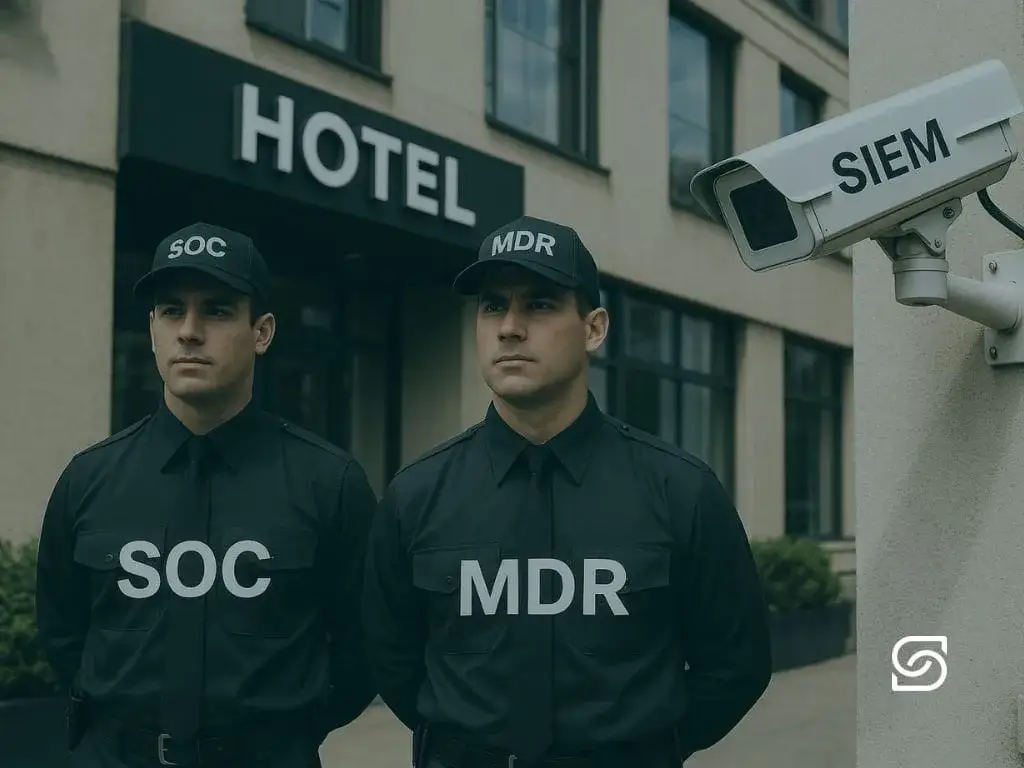
Think about a hotel. MDR and SOC are the security guards patrolling the building and responding when an alarm goes off. They deal with the live event.
SIEM is the CCTV system.
It gives you the footage from before, during and after the incident. You can see where someone entered, where they went, what they accessed and how long they were inside before anybody realised there was a problem.
That is essentially what Security Information and Event Management, or SIEM, does across your IT estate.
MDR and SOC focus on active detection and response. SIEM records, analyses and correlates the activity taking place across your environment. It gives you the wider timeline rather than just the alert that triggered the investigation.
That distinction matters: A login event in Microsoft 365 may not look significant on its own. Neither does an unusual endpoint event or a firewall alert. But when those events are connected and viewed in sequence, they can tell a very different story.
SIEM gives you that context. There is a clear operational case for it as well. Recent Forrester and Microsoft studies reported:
– Up to 88% faster incident response times, helping reduce downtime and reputational impact
– A 79% reduction in false positives, allowing teams to focus on genuine issues
– An 85% reduction in investigation time, cutting the hours spent manually pulling together logs
For a business owner, that translates into fewer disruptions, faster answers and stronger evidence when you need to demonstrate what happened.
Those results are based on organisations already using SIEM, not theoretical projections.
The other important difference is retention. SIEM continuously collects and keeps system logs and alerts for a defined period. That gives you a complete record to work from during an investigation or compliance review.
Other security services do not necessarily retain every event. If the underlying data disappears, so does your ability to reconstruct the incident properly.
If you need to protect client confidence, prepare for an audit or reduce security risk, visibility matters just as much as response. That is the role SIEM plays.
What SIEM does in practical terms
Security Information and Event Management (SIEM) sounds more complicated than it needs to. The easiest way to understand SIEM is to ignore the acronym and focus on the job it performs.
Gartner formalised the term in 2005 by bringing together two existing security disciplines: Security Information Management (SIM), which dealt with log storage, and Security Event Management (SEM), which focused on monitoring activity in real time.
Combined, they created a platform capable of collecting, analysing and correlating security information across different systems.
SIEM originally made the most sense for large organisations.
Enterprises were generating huge volumes of logs and needed a central place to manage them. As cyber attacks became more sophisticated and started moving across endpoints, cloud services and networks, SIEM became far more important than simply storing information for compliance purposes. It developed into a core part of cyber defence.
The technology has also become much more accessible. Cloud-native platforms and managed services mean SIEM is no longer restricted to enterprise IT departments. Smaller organisations can now use it without building a large internal security team.
That is increasingly relevant because most businesses no longer operate within one tidy network.
You have email, cloud applications, endpoints, Microsoft 365, Google Workspace, firewalls, servers and other systems all generating their own security data.
SIEM brings that information together. The benefit is not just central storage. It is what happens once those events are analysed alongside each other.
For example:
– It exposes activity that would otherwise be easy to miss.
A failed login in one system may not raise concern. Unusual access somewhere else may also seem harmless. SIEM can connect those events and show that they form part of the same pattern.
– It keeps the evidence.
If you suffer a breach, you need to know when the activity started, what systems were involved and what was affected. Retained logs allow you to go back and trace that sequence long after the event occurred.
– It gives you the wider incident picture.
MDR may respond to suspicious behaviour on an endpoint and a SOC may handle the live threat. SIEM correlates information across multiple systems and across time, helping you understand the full incident rather than one part of it.
That also makes SIEM useful for proactive IT monitoring.
You are not limited to reacting when something breaks or an alert fires. You can identify patterns, investigate unusual behaviour earlier and use that information to tighten your controls over time.
And importantly, SIEM sits alongside the security tools you already have. It does not replace MDR or your SOC. It makes them more effective by giving them better context.
Why SIEM matters for compliance and audit evidence
Stopping an attack is only one part of cyber security.
There are situations where you also have to prove that appropriate monitoring and security controls were operating at the time. That is where many businesses struggle.
If you are working towards a certification, operating in a regulated sector or answering detailed security questions from a client, you need more than reassurance. You need a consistent record of what has happened across your systems.
SIEM provides that automatically.
It retains logs and event information over time, giving you evidence for compliance checks and detailed investigations after an incident. That provides the traceability auditors are looking for and gives your internal or outsourced IT team a clearer picture of your security posture.
Here is how SIEM aligns with several widely recognised frameworks:
| Compliance framework | Is SIEM required? | What SIEM helps you do |
|---|---|---|
| Cyber Essentials Plus | Recommended | Supports stronger security practices with centralised logging and faster breach detection |
| ISO 27001 | Often needed | Helps with log tracking, incident response and audit preparation |
| FCA (Financial Conduct Authority) | Strongly expected | Supports financial regulation through real-time monitoring and audit-ready records |
| GDPR (UK) | Implied / recommended | Helps track access to data and supports breach reporting within 72 hours |
| NIS2 Directive (UK critical services) | Required for relevant businesses | Supports expected standards around cyber resilience and security visibility |
| CIS Controls (UK guidance) | Explicitly recommended | Supports Control 8 requirements covering logging, correlation and alerting |
| SOC 2 (US / international clients) | Recommended | Helps demonstrate security, accountability and trust to clients outside the UK |
SIEM is not explicitly mandatory in every case. That is not really the point.
The practical value is that it gives you the visibility and evidence that many compliance frameworks expect you to have.
It also makes the wider IT environment easier to manage. Instead of relying on a purely reactive setup, you have a documented record of activity that supports investigations, audits and future growth.
When a regulator, auditor or client asks what happened, you are not trying to piece the answer together afterwards. You already have the evidence.
How SIEM is priced, and why log retention matters
SIEM pricing usually comes down to the number and type of data sources being monitored.
A source is simply a system or service generating logs and security events. Those are the inputs the SIEM platform collects, analyses and retains.
Typical examples include:
| Source type | Example | Purpose |
|---|---|---|
| Microsoft 365 account | Licensed user or shared mailbox | Records user activity, access events and authentication logs |
| Endpoint device | Laptop, desktop | Monitors device activity, login attempts and local threats |
| Firewall | Hardware or cloud-based firewall | Tracks network traffic, intrusion attempts and access patterns |
| Onsite server | Virtual machine or physical server | Records system activity, performance information and access history |
| DUO / DNS Filter / Keeper | Company-wide access and security tools | Captures authentication, filtering and access-control information |
| Wireless access point | Cloud-managed WAP | Records device connections and network behaviour |
Another important part of the cost is retention. Log retention simply means how long your system and security data is kept.
With one-year retention, relevant activity is securely stored for 12 months. That includes events such as login attempts, email access and other system activity.
Why does that matter?
Because security incidents are not always discovered immediately. You may identify suspicious activity today and later find that the initial compromise happened several months ago. If those older logs no longer exist, you cannot properly trace the event back to its starting point.
Twelve months of retention gives you the ability to investigate backwards.
For organisations operating in legal, financial or other regulated industries, retention can also be extended further, including up to seven years where longer-term visibility is required.
So what are you actually paying for?
- A central view of activity across your business systems
- A searchable record you can use for audits and investigations
- Alerts that correlate activity across different platforms
- Faster, more informed decisions when something suspicious occurs
The monthly cost is relatively small compared with trying to investigate a breach without the necessary evidence.
The same applies during a compliance review or when an important client asks how you know your systems are secure. Having the data gives you an answer. Not having it leaves you guessing.
Where SIEM fits in the bigger security picture
The difficult thing about modern cyber threats is that they do not always look dramatic. Often, the early indicators are small.
An unusual sign-in here. A failed authentication somewhere else. An endpoint alert that seems isolated. A change in activity that only becomes significant when you put it next to something that happened several hours or days earlier.
That is exactly why SIEM matters. It gives you visibility across the whole environment rather than forcing you to investigate every system separately.
And from a compliance perspective, you get more than a tick in a box. You get an evidence trail showing what happened and when.
If you already have MDR in place, you have built a strong starting point.
SIEM does not replace that investment. It builds on it by connecting events across the rest of your IT environment and retaining the information you need to understand them properly.
For businesses that want fewer unknowns, faster investigations and a much clearer view of what is happening across their systems, that additional visibility is worth serious consideration.
