This blog was originally published by Corsica Technologies here
Why MSP Readiness Matters More Than Ever
Trust alone is no longer enough
Corsica surveyed 600 IT and security decision-makers at U.S.-headquartered organizations with 200 to 1,000 employees to understand how expectations of MSPs are changing. 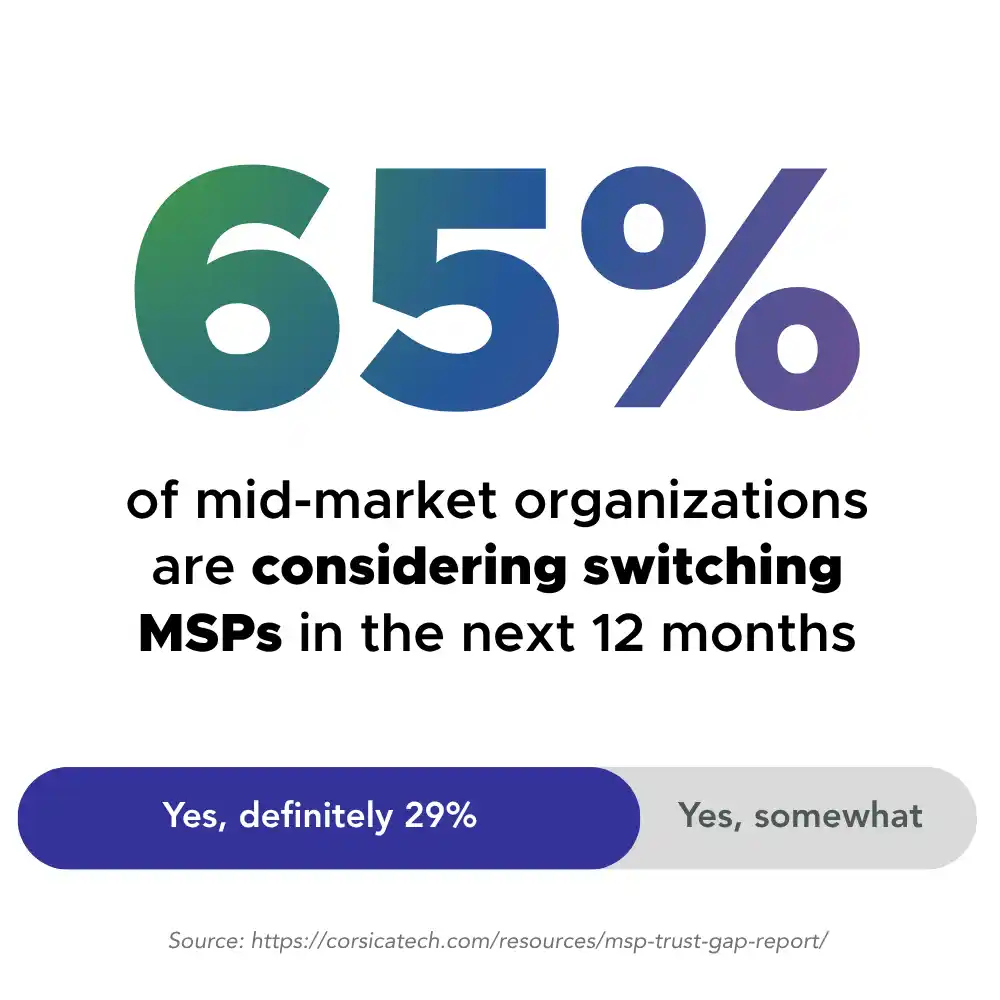
What we found was a market that looks stable on the surface but is clearly shifting underneath. Most respondents say they trust their current provider, and many are satisfied with the strategic guidance they receive. Yet 65% say they are considering switching MSPs within the next 12 months.
That tension matters. It tells us customers are no longer evaluating providers only on what has worked in the past. They are asking whether their MSP is equipped for where the business is going next.
From satisfaction to readiness
Satisfaction measures the past; readiness measures what comes next. A provider may be doing the job today and still fall short of what the customer believes it will need tomorrow. The market is no longer buying support alone. It is buying confidence that the provider can help the business keep moving.
In our survey, respondents ranked cybersecurity operations and risk reduction at 36%, data integration across tools and systems at 35%, and AI readiness and enablement at 33% among the top responsibilities they expect a partner to own or strongly support in 2026.
These expectations point to a broader redefinition of the MSP category. Customers are not looking for a vendor that only reacts to tickets. They are looking for a partner that can help make the business more secure, more connected, and more prepared for change.
They are not simply asking whether a provider can maintain the current environment. They want to know whether that provider can reduce risk, remove barriers to growth, and keep pace as technology and business priorities evolve.
Data integration and AI are moving to the center
Data integration is one of the clearest examples of this shift. Nearly every respondent, 99.7%, says data integration is important when evaluating a technology partner, while 35% expect a partner to own or strongly support it in 2026.

The reason is straightforward. Disconnected systems create friction. They slow decisions, limit visibility, and make it harder for teams to work from consistent information. They also limit the value organizations can get from automation and AI, because AI depends on reliable access to connected, usable, governed data.
AI is following a similar path. Among respondents considering a switch, 33% cite limited support for AI and automation as a top reason.
This is more than a feature gap. It is a strategic risk for providers. MSPs that cannot help customers move from AI experimentation to practical, secure implementation will lose relevance faster than many expect.
Data integration and AI are no longer side conversations. They are becoming clear measures of whether a provider can support the customer’s next phase of growth.
Where provider friction still shows up
At the same time, familiar frustrations have not disappeared. Slow response times at 27%, unpredictable billing at 26%, and limited data integration support at 25% rank among the top pain points respondents report with their current MSP.
These issues do more than frustrate customers. Slow responses delay action. Billing uncertainty makes planning more difficult. Weak integration support leaves teams managing complexity their provider should be helping them reduce.
Together, these problems create business drag and gradually erode confidence in the relationship.
In a market where customers are reconsidering what they need from a provider, routine friction carries greater weight. A relationship that is hard to manage today is unlikely to feel capable of supporting a more demanding tomorrow.
The next phase of MSP value
The bigger story is not simply that some customers are dissatisfied. The market is setting a higher bar for strategic relevance.
Customers want providers that are easy to work with, transparent in how they operate, and capable of helping the business navigate change. They expect their MSP to understand where the organization is going, not just maintain where it is today.
The providers that lead in this environment will not be the ones that simply maintain coverage or close tickets faster. Those capabilities matter, but they are expected. The leaders will make complexity manageable, align their work to meaningful business outcomes, and operate as a true extension of the customer’s team.
Support is expected. Readiness is differentiated.
The next generation of MSP leaders will be selected not only for how quickly they respond, but for how well they help customers prepare for what comes next.
At Corsica, we believe technology should make business easier to run, not harder. In today’s environment, that means bringing the expertise, structure, and accountability organizations need to modernize securely, adopt AI responsibly, and build the operational foundation for what comes next.
For a closer look at what mid-market IT and security leaders are telling us about the future of the MSP relationship, download our latest report, The MSP Trust Gap, and data sheet, The New MSP Standard.