This blog was originally published by TruAdvantage here
Who Owns AI in Your Business? A Practical Guide to Roles and Accountability
If an employee wants to use a new AI tool, who approves it? If the tool produces an inaccurate client communication, who reviews it? And if confidential information is shared accidentally, who needs to know?
For small and midsize businesses, these questions highlight an important part of AI adoption: clear responsibility.
An organization may have approved software and a written AI policy, yet still lack a consistent process for making decisions. Employees need to understand who can authorize a use case, who evaluates the risks, and who is responsible for the results.
A workable approach combines one accountable program owner with clearly defined responsibilities across the business.
Where Ownership Gaps Develop
Consider a hypothetical professional services firm. Marketing uses AI to draft content, operations experiments with meeting summaries, and a department manager wants to connect an AI assistant to internal files.
Leadership assumes IT is evaluating every tool. IT assumes managers have approved the business uses. Managers assume employees understand what information they can share.
Each group sees part of the process, but nobody has confirmed who owns the decisions.
These gaps can create inconsistent practices. A tool approved for public marketing content might later be used for confidential client documents without further review. An employee might treat an AI-generated summary as accurate because no reviewer was assigned.
Defining ownership helps teams recognize when a proposed use needs approval, when circumstances have changed, and where to raise concerns.
Leadership Sets Direction and Decision Authority
Leadership determines the business objectives for AI and the boundaries within which employees can pursue them.
That includes identifying worthwhile priorities, allocating resources, and deciding which uses require additional scrutiny. Leaders also need to designate an accountable AI program owner.
In a smaller business, this could be an operations director, IT leader, or another manager with authority to coordinate across departments. It does not necessarily require a new position.
Leadership should answer four questions:
- What business outcomes are we trying to improve?
- Who can approve or decline a proposed AI use?
- Which decisions require specialist advice?
- Who resolves disagreements between departments?
The owner needs enough authority and time to carry out the role. Assigning responsibility without either can leave the program dependent on informal conversations and unfinished tasks.
The AI Program Owner Coordinates Decisions
The program owner keeps the process consistent and ensures that decisions receive follow-through.
This person maintains a record of approved tools and uses, coordinates reviews, and tracks unresolved questions. They also make sure employees know where to ask for guidance.
The role does not require personally evaluating every technical, legal, or operational issue. It requires bringing the appropriate people into the decision and documenting the outcome.
For example, if a department proposes an AI meeting assistant, the program owner would coordinate questions about the business need, information captured, access, retention, and any relevant notice or consent requirements.
The approval should describe the permitted scope. A decision to allow the tool for one type of meeting should not automatically authorize it for every conversation.
IT and Security Evaluate Technology and Access
IT and security assess whether a tool’s configuration and information access are appropriate for the proposed workflow.
Relevant questions include:
– What information will the tool receive or access?
– Does it connect to email, shared folders, or other business systems?
– Who can administer accounts and permissions?
– What data-handling settings and controls are available?
– How will access be removed when someone changes roles or leaves?
A request to rewrite public website copy is different from a request to search confidential client folders. Business teams must explain the intended task so IT can evaluate the actual use.
Where an external IT provider is involved, the business should clarify which evaluations and controls the provider handles. Internal leadership still needs to own business priorities and approval authority.
Department Managers Own Workflows and Results
Department managers understand the work well enough to identify useful applications and assess whether the results are acceptable.
Their responsibilities include defining the task, assigning a qualified reviewer, and measuring whether AI improves the process.
Suppose a team wants AI to draft routine client updates. The manager should establish the approved source material, required content, review steps, and conditions for sending the final message.
Managers should also evaluate the complete workload. A draft produced in seconds may offer little benefit if correcting it takes longer than preparing the communication manually.
Useful measures include total completion time, revision effort, accuracy, and consistency. These help determine whether a workflow should continue, change, or stop.
Employees Follow Approved Practices and Raise Concerns
Employees need instructions they can apply during everyday work.
They should know which tools and uses are approved, what information they may share, and what review is required before using an output.
Their responsibilities include checking AI-generated work, staying within approved boundaries, and asking when a task falls outside those boundaries.
Employees also need a clear route for reporting mistakes or suspected data exposure. A named contact and straightforward reporting process make it easier to raise a concern promptly.
Training should use examples relevant to their roles. “Use AI responsibly” provides little guidance unless employees understand what responsible use looks like in their own work.
HR, Legal, and Compliance Provide Specialist Input
Some AI uses require expertise beyond operational and technical review.
HR, legal, or compliance advisers may need to assess proposed uses involving employment decisions, client confidentiality, contractual commitments, or regulated information. Smaller businesses may obtain this support externally.
For example, drafting a general office announcement and evaluating job applicants involve different considerations. The approval process should identify when specialist review is necessary.
The program owner coordinates that input and ensures any resulting conditions become part of the approved workflow.
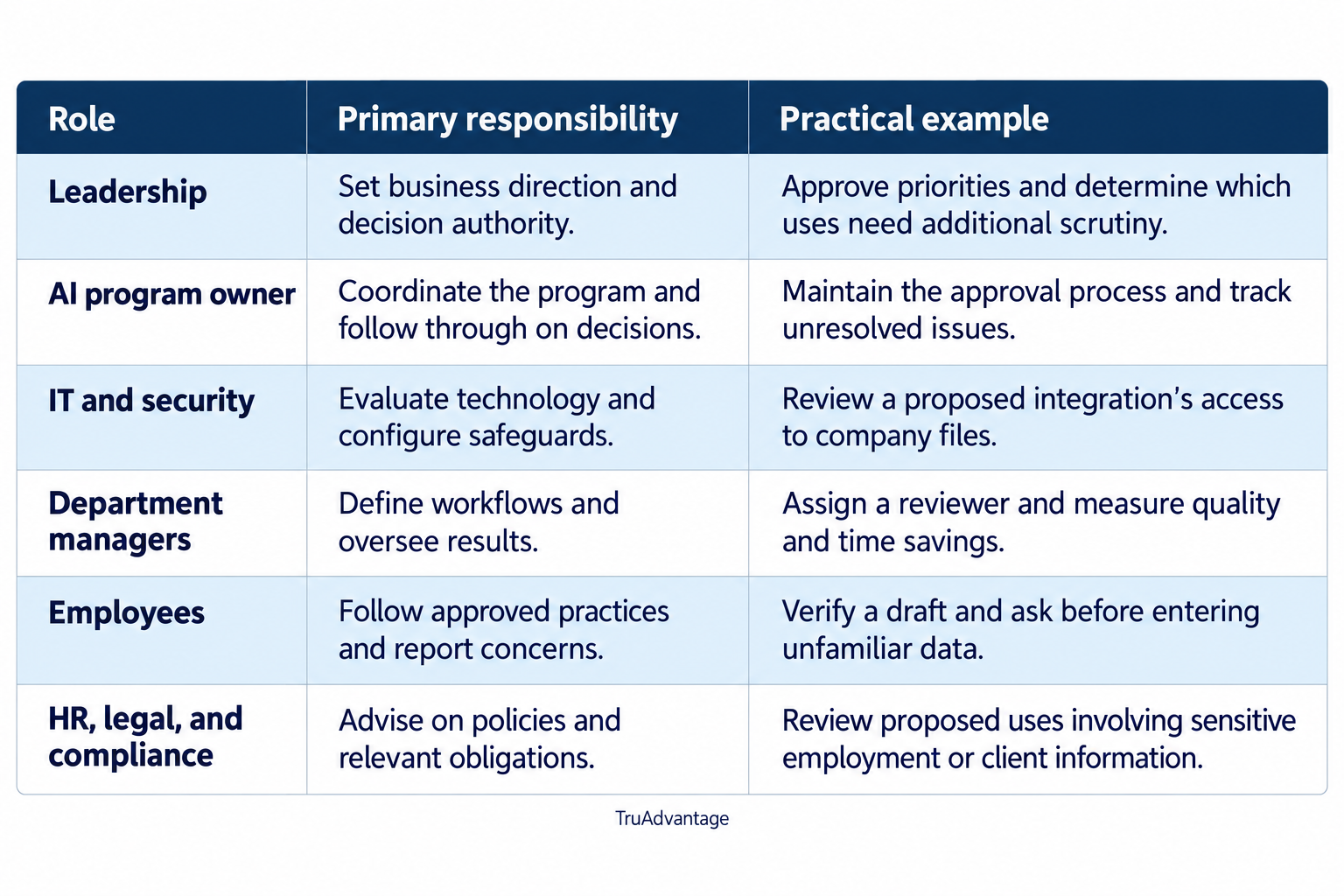
A Practical Responsibility Map
The following model can serve as a starting point. In a smaller organization, one person may hold several roles.
Keep the Approval Process Proportionate
A useful approval process should gather enough information to support a decision without making routine requests unnecessarily difficult.
A short request form can capture:
- The task and expected benefit.
- The proposed tool.
- The information and system access required.
- The person responsible for reviewing outputs.
- The consequences of an incorrect result.
The department manager assesses the workflow. IT and security evaluate the technology and access. The program owner coordinates any specialist review and records the decision.
Approvals should be revisited when the scope changes. Connecting an existing tool to additional company files, introducing more sensitive information, or allowing it to take actions automatically can change the risk.
Start With One Existing Workflow
Organizations can test their ownership model against an AI workflow already in use.
Identify who approved it, what information it uses, who checks its results, and where employees report concerns. Any unanswered question reveals a responsibility that needs clarification.
The next leadership discussion can begin with a simple question:
Who is accountable for AI in our business, and what decisions does that person own?
Documenting the answer gives employees a clearer path to using AI and gives leadership a practical way to oversee its adoption.